
Last Updated: October 30, 2026
Quick Summary
No, a 3% credit card surcharge is not automatically illegal, but it is legal only when federal rules, card network rules, state law, and your payment processor agreement all allow it. Card networks generally cap a credit card surcharge at your actual cost of acceptance, with 3% as the commonly referenced ceiling.
- State surcharge laws can be stricter than federal or card network policy and may cap fees below the network ceiling.
- You must notify your card networks and payment processor in advance before adding a surcharge.
- Disclose the surcharge on point-of-sale signage, online checkout before payment, and as a separate receipt line.
- If your actual cost of acceptance is 2.4%, your surcharge must stay at or below 2.4%, not 3%.
- A surcharge, a convenience fee, and a cash discount are three different things with different rules.
Table of Contents
- Is a 3% Credit Card Surcharge Illegal?
- Credit Card Surcharge Laws by State
- The 3% Cap: Card Network Rules vs. State Law
- Credit Card Processing Fee Disclosure Requirements
- Surcharge vs. Convenience Fee vs. Cash Discount
- How to Implement Credit Card Surcharging at Your Business
- Calculating a Compliant 3% Fee: Worked Examples
- Get Your Surcharge Setup Reviewed Before You Go Live
- Frequently Asked Questions
Is a 3% Credit Card Surcharge Illegal?
No, a 3% credit card surcharge is not automatically illegal, but it is tightly controlled. A credit card surcharge is an extra fee a merchant adds when a customer pays with a credit card, and it is legal only when federal rules, card network rules, state law, and your payment processor agreement all allow it.
Three separate rulebooks govern this. Federal law sets a national baseline. Card network rules cap the amount. State law can add restrictions or ban the practice outright.
Here’s what most guides get wrong: they treat “is it legal” as a single yes-or-no question. It isn’t.
Below, we’ll show you exactly how each test works, which states restrict surcharges, and how to calculate a compliant 3% fee.
Credit Card Surcharge Laws by State
Credit card surcharge laws by state vary widely, and state rules can be stricter than federal or card network policy. Some states allow surcharges with conditions. Others cap them below the network ceiling, and a few restrict or prohibit the practice entirely.
The most useful way to read the state layer is to separate it from the other two rulebooks. A surcharge can be legal under federal law and within the card network cap and still be illegal where you operate. The state statute is the binding constraint on your side of the counter.
How to read your state’s rule
Most state surcharge statutes fall into one of four buckets. Knowing which bucket your state is in tells you what to check next:
- Permitted with conditions. The state allows a credit card surcharge but requires specific disclosure wording, a cap, or both. You can charge a fee, but the signage and receipt language are prescribed.
- Capped below the network limit. The state sets its own maximum, often lower than the network ceiling, so the effective cap is the state number, not the network number.
- Restricted or prohibited. The state bans surcharges outright or limits them to narrow circumstances. In these states, a cash discount is usually the compliant alternative.
A practical state lookup routine
Rather than rely on a static list that goes stale, run this lookup before you launch or change a program:
- Search your state attorney general’s site for “surcharge” and “credit card” together.
- Check whether your state’s consumer protection statute addresses surcharges, convenience fees, or cash discounts separately.
- Note any stated cap and compare it to the network ceiling, the lower number wins.
- Note any required disclosure wording, sign placement, or receipt format.
- Confirm whether the state treats a surcharge and a cash discount differently, because some statutes do.
- Recheck before each major policy change and whenever you add a new location or state.
When state and network rules disagree, follow the stricter one. That single habit prevents most compliance problems, and it is the fastest way to stay compliant without memorizing every statute.
Where merchants get the state question wrong
The common mistake is assuming that because the card networks allow a surcharge up to the merchant’s cost of acceptance, the state must allow it too. It does not work that way.
If you operate in more than one state, build a simple matrix: one row per state, columns for permitted/prohibited, cap, disclosure requirement, and cash-discount treatment. Update it on a set schedule.
The 3% Cap: Card Network Rules vs. State Law
A 3% ceiling is commonly cited in card network rules rather than in a single federal statute. Card brands generally limit a credit card surcharge to the merchant’s actual cost of acceptance, and 3% is the commonly referenced ceiling.
Here’s the distinction that matters:
- Federal law sets a national baseline for surcharges and disclosure.
- Card network rules set the 3% ceiling and require notice to the networks.
- State law can lower the cap or restrict the practice.
So a 3% surcharge that clears one test can still fail another. For a clear breakdown of the credit card processing fees small business owners pay, see our fee guide. The 3% limit is a ceiling, not a target.
Credit Card Processing Fee Disclosure Requirements
Credit card processing fee disclosure requirements are strict, and this is where most merchants slip up. The FTC guidance on unfair and deceptive fees stresses that hidden or surprise charges can be treated as deceptive.
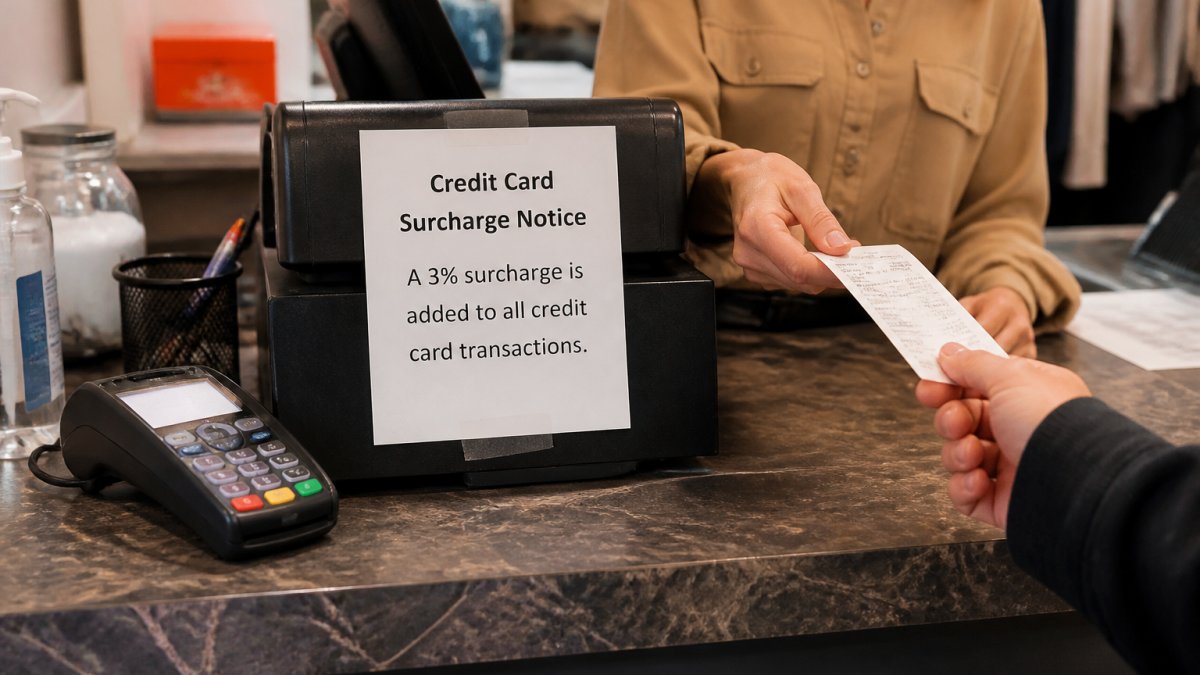
The disclosure duty has three layers, and each one has its own audience: the customer at the point of sale, the customer at online checkout, and the customer reading the receipt. A compliant program covers all three with consistent wording.
Layer 1: Point-of-sale signage
A compliant sign does four things: it states that a surcharge applies, it states the percentage, it states that the fee applies only to credit card payments, and it is placed where the customer sees it before paying. Vague wording like “extra fees may apply” does not count. Say the number. (Source: National Conference of State Legislatures (NCSL) overview)
A workable sign reads: “A 3% surcharge is added to all credit card payments. Debit and cash payments are not subject to this surcharge.” If your state requires specific wording, use the state wording and add the percentage. Place the sign at the register and at any secondary payment point, not only on the door.
Layer 2: Online checkout disclosure
The online equivalent is a notice that appears before the customer enters card details, not on the confirmation page after payment. A compliant pattern is a line in the order summary that reads: “A 3% credit card surcharge applies to credit card payments and will be added at checkout.” The cart total should update to show the surcharge as a separate line before the customer clicks pay.
Layer 3: Receipt line item
The receipt must show the surcharge as its own line, not folded into the total. A compliant receipt shows the base amount, the surcharge amount, and the final total as separate figures. For a $100 sale at 3%, the receipt reads: base $100.00, credit card surcharge $3.00, total $103.00. If your actual cost of acceptance is lower than 3%, the receipt line must reflect the lower rate you actually charged.
The most common disclosure failure is inconsistency: a sign that says 3%, a checkout that says 2.5%, and a receipt that shows a flat dollar amount. Customers notice, and inconsistent numbers are the easiest complaint to substantiate. Pick one rate, apply it everywhere, and make the wording match across all three layers.
What good disclosure looks like in practice
| Channel | What to show | What to avoid |
|---|---|---|
| In-store sign | Percentage, credit-card-only scope, placement before payment | “Fees may apply” language |
| Online checkout | Surcharge line in order summary before payment | Notice only in terms and conditions |
| Receipt | Separate surcharge line with dollar amount | Surcharge folded into total |
Good disclosure covers four points consistently across every channel: a clear sign at the point of sale and online checkout, the surcharge amount stated as a percentage, the fee shown as a separate line on the receipt, and notice given before the customer completes payment. If any one of those is missing or contradicts the others, the disclosure is not compliant.
Surcharge vs. Convenience Fee vs. Cash Discount
These three terms are not interchangeable, and mixing them up is a common compliance mistake. A credit card surcharge is added only when a customer pays by credit card. A convenience fee applies to a specific payment method or channel, such as a phone or online payment, and comes with its own network conditions. A cash discount lowers the price for paying cash and is generally treated differently from a surcharge.
If you’re weighing how to structure charges, understanding your underlying cost model matters. Our guide to flat fee vs interchange plus processing fees explains how each pricing model affects what you can fairly pass on.
| Fee Type | What It Does | Key Rule |
|---|---|---|
| Surcharge | Adds a fee for credit card use | Capped at actual cost and 3% |
| Convenience fee | Charges for a specific channel | Separate network conditions apply |
| Cash discount | Lowers price for cash | Treated differently from a surcharge |
Pick one approach and apply it consistently. Combining them carelessly invites scrutiny.
How to Implement Credit Card Surcharging at Your Business
How to implement credit card surcharging comes down to a sequence, not a single step. Follow it in order:
- Confirm your state allows surcharges and note its cap.
- Calculate your actual cost of credit card acceptance.
- Notify your card networks and payment processor in advance.
- Update signage and online checkout to show the fee clearly.
- Print the surcharge as a separate receipt line.
- Train staff to explain the fee on request.
- Review your setup whenever rules or costs change.
Watch out: skipping the advance notice to your processor is the mistake that sinks otherwise compliant programs. When you’re ready to set up, explore our small business payment processing services. Networks require it, and processors can flag accounts that add fees without warning.
Calculating a Compliant 3% Fee: Worked Examples
A compliant fee is simple math: the surcharge equals a percentage of the transaction amount, and it can never exceed your actual cost or the 3% cap. Here’s how that plays out.
- A $100 credit card sale: a 3% surcharge adds $3.00, bringing the total to $103.00.
- A $250 credit card sale: 3% adds $7.50, for a $257.50 total.
- A $40 credit card sale: 3% adds $1.20, for a $41.20 total.
Now the important part. If your actual cost of acceptance is 2.4%, your surcharge must stay at or below 2.4%. On a $100 sale, that’s $2.40, not $3.00.
Get Your Surcharge Setup Reviewed Before You Go Live
Getting the rules right on paper is one thing. Getting them right at the register, on every receipt, and in every processor setting is another.
Local Credit Card Processing offers transparent pricing, free equipment, and dedicated local tech support, which can help you add a compliant fee.
Before you launch, have someone check the details. You can contact us to have your surcharge configuration reviewed.
Frequently Asked Questions
Is it federally illegal to charge a credit card fee?
There is no federal law that bans credit card surcharges outright. Federal rules mainly require clear disclosure and prevent surcharges from exceeding the merchant’s actual cost of acceptance. The bigger constraints come from state laws and card network rules. Several states restrict or prohibit surcharges, and card brands cap them at 3% of the transaction amount. Check your state’s statute and your merchant agreement before adding a fee.
Can businesses charge a fee for debit card transactions?
Generally no. Card network rules allow surcharges on credit card transactions but not on debit card or prepaid card payments. A merchant that surcharges credit cards must still accept debit cards without the fee. Some businesses use a cash discount instead, which lowers the price for cash payments rather than adding a charge for cards. Confirm the rules with your payment processor before changing your checkout.
Does the 3% fee limit apply to all payment processors?
The 3% cap comes from card network rules, so it applies to any merchant that accepts those cards, regardless of which payment processor or acquirer handles the transaction. Your merchant agreement may add its own terms, such as registration or advance notice requirements. State law can also set a lower limit or ban surcharges entirely. The processor enforces the rules but does not set the cap.
What are the disclosure requirements for credit card surcharges?
Card network rules require clear disclosure at the point of sale and on the receipt. Post the surcharge amount at the entrance and at the register or online checkout, and show the fee as a separate line item on the receipt. The disclosed amount must match what you actually charge. Some states add their own notice rules, so check your state law and your merchant agreement for specifics.
Charging a 3% fee is legal only when every rulebook agrees, and one missed detail can undo the whole program. Local Credit Card Processing makes that setup simpler with free equipment, transparent pricing, and dedicated local tech support that answers when you need it. Get started with Local Credit Card Processing and launch a surcharge program you can stand behind.

Recent Comments